
2026-07-06
GaN vs Silicon Charger: What is the Difference?
GaN and silicon are the two charger technologies. This comparison explains the real-world differences in size, efficiency, heat, and price.
Traditional chargers have relied on silicon-based power semiconductors for decades.
More recently, GaN — Gallium Nitride — has become increasingly common in USB-C, laptop and high-power chargers.
So what is the difference between GaN and silicon chargers?
The short answer is:
GaN can enable higher power density and more compact charger designs, while silicon remains a mature and widely used power semiconductor technology.
But the real answer is more nuanced.
GaN vs Silicon: Quick Comparison
| Feature | GaN Charger | Traditional Silicon Charger |
|---|---|---|
| Semiconductor | Gallium Nitride | Silicon |
| Power density | High potential | Mature |
| Switching frequency | Can be higher | Generally lower |
| Compact design | Strong advantage | Usually larger at comparable power |
| High-power applications | Excellent | Widely used |
| Cost | Can be higher depending on design | Mature and cost-effective |
| Thermal design | Still important | Still important |
| USB PD support | Possible | Possible |
What Is GaN?
GaN stands for Gallium Nitride.
It is a wide-bandgap semiconductor material used in power electronics.
In charger applications, GaN devices can switch at high frequencies and support efficient power conversion.
This can allow designers to reduce the size of some magnetic and passive components and achieve higher power density.
What Is Silicon?
Silicon is the traditional semiconductor material used in power electronics.
Silicon-based charger designs are mature, widely available and well understood.
They remain common in:
Wall chargers
Laptop adapters
Power supplies
Industrial equipment
Consumer electronics
The emergence of GaN does not mean silicon chargers have become obsolete.
Why Are GaN Chargers Smaller?
One important advantage of GaN technology is that it can enable higher switching frequencies.
Higher switching frequency can allow certain components in the power-conversion system to become smaller.
Combined with modern circuit design, this can help reduce the overall charger size.
However, charger dimensions are influenced by the complete design, not just the semiconductor.
A charger also needs:
Transformer or magnetic components
Capacitors
EMI filtering
Rectification
Cooling
Protection circuitry
USB PD control
Mechanical insulation and enclosure
Therefore, GaN should be considered an enabling technology rather than a guarantee of a specific size.
GaN and Efficiency
Efficiency is another important reason GaN is attractive.
Lower power losses mean less energy becomes heat.
Reduced losses can make it easier to design compact chargers that maintain acceptable thermal performance.
However, you should not assume that every GaN charger is automatically more efficient than every silicon charger.
Actual efficiency depends on:
Circuit topology
Component selection
Load level
Thermal design
Control strategy
PCB layout
Power rating
The complete charger design matters.
Why Is GaN Popular for 65W and 100W Chargers?
65W and 100W are particularly useful power levels for modern laptops.
At these output levels, users want both:
High power + small size
That is where GaN becomes attractive.
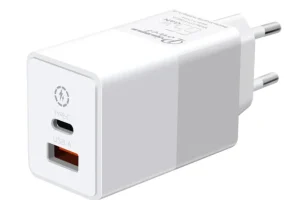
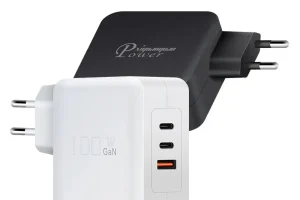
Powgent’s charger lineup includes 65W and 100W GaN solutions for laptops, tablets and multi-device applications.
What About 140W GaN Chargers?
The advantage becomes even more relevant as output power increases.
USB PD 3.1 introduced EPR, enabling USB-C power levels above the traditional 100W range.
Powgent’s 140W PD 3.1 GaN charger products are designed for high-power laptops and USB-C applications.
This is an example of how GaN and higher-power USB PD can complement each other.
Is GaN Safer Than Silicon?
It is better not to describe GaN simply as “safer.”
Safety depends on the complete charger design.
A safe charger requires appropriate:
Over-voltage protection
Over-current protection
Short-circuit protection
Over-temperature protection
Insulation
EMI design
Component selection
Certification and compliance testing
GaN is a semiconductor technology, not a safety certification.
Is GaN More Expensive?
Historically, GaN components and related designs could cost more than conventional silicon solutions.
However, production volume and technology development have improved the economics of GaN charger manufacturing.
The final product cost depends on:
Power rating
Number of ports
GaN generation
Controller
Transformer
Components
Certifications
Housing
Cable
Packaging
Therefore, comparing only “GaN vs silicon” is not enough to determine final charger price.
GaN vs Silicon for Laptop Chargers
Choose GaN when you prioritize:
Compact size
High power density
Travel portability
65W–140W power levels
Multi-port charger design
Premium product positioning
Silicon may still make sense when:
Cost is the main priority.
Charger size is less important.
The application already has a proven silicon design.
The required power level does not justify a new architecture.
GaN Does Not Determine Compatibility
This is important.
A GaN charger can support USB PD.
A silicon charger can also support USB PD.
Compatibility depends on the charging protocol, output profiles, connector and device requirements.
So when choosing a laptop charger, don’t ask only:
“Is it GaN?”
Also ask:
What is the output wattage?
Does it support USB PD?
What voltage profiles are available?
How many ports does it have?
How is power distributed?
Is the cable suitable?
Does it have the required certifications?
Final Thoughts
GaN has become an important technology for modern charger design because it can help manufacturers achieve higher power density and compact form factors.
Silicon, however, remains a mature and capable technology.
The real advantage of GaN appears when manufacturers combine the semiconductor technology with good power architecture, thermal management and product engineering.
For compact USB-C laptop chargers, 65W, 100W and 140W GaN products are increasingly important categories.
FAQ
Is GaN better than silicon?
GaN offers advantages for power density and compact high-power designs, but overall charger performance depends on the complete circuit and product design.
Are GaN chargers worth it?
They can be particularly useful if you want a compact charger with relatively high power output.
Do GaN chargers charge faster?
Not automatically. Charging speed depends on the charger’s power output, protocol and the device’s charging capability.
Are GaN chargers cooler?
GaN can reduce certain power losses, but actual operating temperature depends on the complete charger design and load.
Is silicon still used in chargers?
Yes. Silicon remains widely used in power electronics and charger products.
Related Products
Related Articles
Have Questions About Chargers?
Our engineering team is ready to help. Send us your inquiry — we respond within 24 hours.
Response within 24 hours
Need OEM or Private Label?
Get Your Quote Within 24 Hours. From logo printing to full custom design — we are your GaN charger manufacturing partner.